Bankruptcy litigation analytics
The trustee has a number. It isn’t yours.
Preference demands are computed from the debtor’s records — not from the payment history that actually decides these cases. We analyze your own AR data under §547’s defenses and deliver the result as expert-grade work product, through your counsel, for a flat fee.
Why you received that letter
When a customer files for bankruptcy, the trustee can seek to recover payments the company made to its suppliers during the 90 days before the filing — even payments on legitimate invoices, delivered in full. Demands and lawsuits typically arrive in waves, often close to the two-year filing deadline, and they carry real response clocks: a filed complaint generally requires an answer within about 30 days, and unanswered complaints routinely end in default judgments for the full amount demanded.
The demand is usually built from the debtor’s disbursement records alone. It does not account for the statutory defenses Congress wrote into §547 — defenses that can only be computed from your records: your invoices, your payment dates, your shipments.
Because these letters are generated from a list of everyone the company paid, they are not limited to trade suppliers on credit terms. They also reach businesses paid cash in advance or on delivery, brokers and agents who passed funds along, factors and others who took assignment of a receivable, service providers and contractors paid as work was performed, and revenue-share or joint-venture counterparties. A trustee must establish specific elements to recover a payment, and those elements are not the same for every recipient. Part of what we do is set out, from your own records, the facts bearing on that question — the timing between payments and invoices, how a receipt was classified in your books, who issued the invoice and who was paid — so your counsel can evaluate what they mean for you.
Whatever you do, don’t ignore it. If you have been served, speak with bankruptcy counsel promptly — never disregard a summons.
We compute the number the demand leaves out
One engagement covers one customer bankruptcy. You provide an AR export and a shipment log — plus the trustee’s schedule of alleged transfers if you have it; otherwise we pull it from the public docket. We do the rest.
01
Reconciliation
We match the trustee’s exhibit against your ledger line by line: transfers dated outside the 90-day window, payments attributed to you that aren’t in your books, the same payment listed twice, and payments made before any invoice for them existed. Errors in the demand are identified and documented first. Some cases end here.
02 — §547(c)(2)
Ordinary course of business
§547(c)(2) protects payments consistent with the parties’ historical dealing. We build your days-to-pay baseline from years of pre-distress history and score every challenged payment under each of the methodologies courts accept — with a sensitivity table showing the protected range under each, so your counsel can see the strongest framing and its alternatives.
03 — §547(c)(4)
Subsequent new value
§547(c)(4) credits goods and services you continued to ship after each challenged payment, sequenced transfer by transfer. We construct the running new-value ledger from your shipment log.
04
Net exposure
Defenses are stacked in the optimal order per transfer, producing a documented exposure band — worst case, expected, best case — against the amount demanded. Findings that turn on legal judgment are flagged for your counsel, stated as open questions, never silently resolved.
The graphic that frames the negotiation
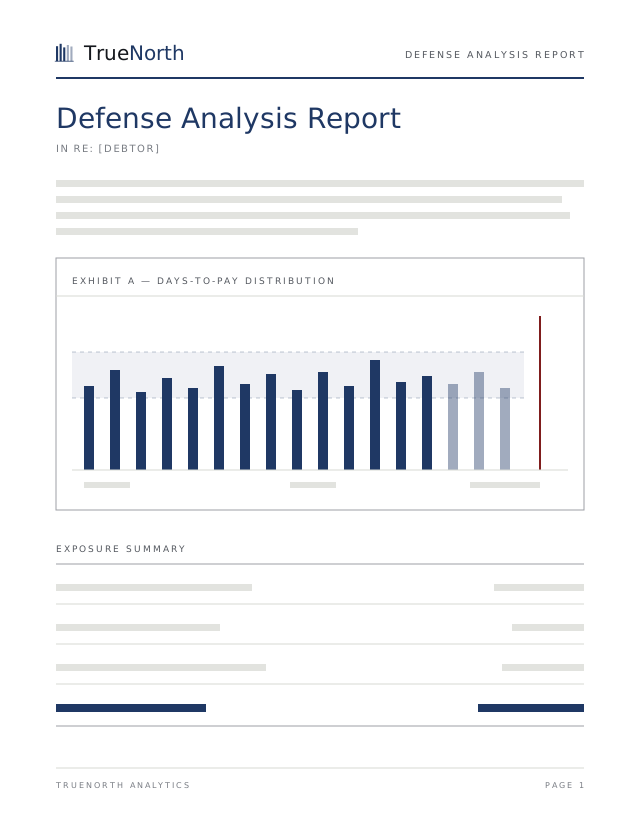
The core exhibit in most preference defenses is a simple one: your customer’s payment timing, before distress and during the preference period, on one chart. When the preference-period payments fall inside the historical pattern, that consistency is the ordinary-course defense — made visible. Every analysis includes this exhibit, built from your data, formatted to survive scrutiny by the trustee’s counsel.
Days-to-pay distribution
Illustrative example- Baseline-period payments
- Preference-period payments
- Petition date
Three documents, built for your counsel’s use
-
Defense Analysis Report
The exposure waterfall, the payment-timing analysis, the new-value ledger, and a per-transfer status classification with rule citations — every accepted methodology computed in parallel and presented side by side, never pre-selected. It opens with threshold observations: the facts in your records bearing on what a trustee must establish in the first place — how payment dates line up against invoice and delivery dates, how receipts were classified in your books, which entity issued the invoice and which was paid. It closes with how those figures were arrived at: the order the analysis was performed in, in plain sentences, with the actual figures at each step. Behind the report sits a complete derivation — every figure recorded with the calculation that produced it and the records it drew on — retained for your engagement and available to be produced where there is a legal reason to.
-
Settlement memo
Net exposure against the demand, settlement context from the same case’s docket where available, and defense-cost benchmarks — the one-page economics of the decision in front of you.
-
Workpapers
An Excel workbook carrying every figure in the report on the sheet and the row it was built on, traced to the record it came from, so any total can be checked by adding the column above it. Before release every figure is machine-recalculated and must reproduce the reported number to the penny. The record of the calculations themselves is retained for your engagement and can be produced where there is a legal reason to.
Turnaround is typically 48–72 hours from complete data. Your side of the lift: one AR export and one shipment log. Every engagement ships with a manifest recording cryptographic hashes of the input files and the result of every automated check.
The other way a creditor loses: an objection to your claim
Late in a large bankruptcy, the estate turns on the claims register. A plan administrator or trustee files an omnibus objection — one filing attacking dozens or hundreds of claims at once, each listed on an exhibit with a stated ground and a proposed outcome: disallow the claim, shrink it, or move it to a class that recovers pennies. There is no lawsuit and no defendant. There is a response deadline, typically about thirty days from filing, stated in the objection’s notice — and if it passes silently, the proposed order can be entered as drafted.
This reaches creditors a preference suit never could. We analyze what your own records show about each asserted ground, in plain language: a claim listed as a duplicate (including the two-claims-against-two-different-debtors listing that often isn’t one); a claim said to be amended and superseded (checking the objection targets the right link of the chain); a claim said to be already paid (reconciled against your receipt ledger); a priority reclassification — the money ground, because goods the debtor received in the 20 days before the filing are typically paid in full while ordinary unsecured claims are not; insufficient documentation (with the exhibit list that cures it); a claim called late-filed (bar-date arithmetic; whether a late filing is excusable is your counsel’s question); and a claim said to be inconsistent with the debtor’s books and records.
For that last ground — the most common one — the deliverable is a bridge: starting from your ledger balance, subtracting the invoices the debtor’s schedules missed and the credits you haven’t booked, and showing exactly where the difference the objection relies on comes from. The findings are stated as what the records show, never as legal conclusions — and when your own records support the objector, the report says so plainly, because knowing that before you spend money responding is exactly the point.
Deadline discipline is built in: we read the response deadline from the notice document itself, and we decline engagements that arrive too close to it — an analysis rushed against the deadline risks missing it, and missing it is how a claim is lost.
You receive two documents through your counsel — an Objection Response Analysis report and workpapers carrying every figure on the sheet and row it was built on — for the same flat-fee schedule as our preference work, keyed to the claim amount under objection. See the fee schedule · What to send
Books-and-records bridge
Illustrative exampleHow an engagement runs
-
Send the demand and your data.
The trustee’s exhibit or demand attachment, an AR export for the customer (invoice dates, amounts, terms, payment dates), and a shipment log through the filing date. We confirm scope and fee in writing before any work begins.
-
We run the analysis.
Reconciliation, ordinary-course scoring under each accepted methodology, new-value sequencing, exposure banding — under a documented QA protocol that verifies every total against source records.
-
Your counsel takes it from there.
The deliverables are designed to be handed to your bankruptcy attorney — and, through them, to the trustee’s side. We support your counsel’s questions; we don’t negotiate, appear, or advise on legal strategy.
A flat fee, quoted before we start
Engagements are a fixed, scoped fee — $2,500, $3,500, or $5,000, keyed to the size of the schedule against your company — agreed in writing before work begins. We take no percentage of your settlement, your recovery, or the reduction achieved. Compare that to negotiating against a six- or seven-figure demand on the trustee’s numbers alone.
Common questions
-
Are you a law firm?
No. We are an analytics firm. We compute and document findings from records; we do not provide legal advice, and every engagement is structured for presentation through your own bankruptcy counsel. If you don’t yet have counsel, engaging one promptly should be your first step.
-
Is the amount in the letter what I owe?
A demand is an allegation, not an adjudication — and a listing in a debtor’s schedules does not establish that any amount is owed. What you ultimately pay, if anything, typically depends on the defenses that can be documented from your records.
-
We were paid up front, or we only passed the money through. Why did we get this?
Because the list is generated from the debtor’s disbursements, not from a review of who was a creditor. Recipients paid cash in advance or on delivery, agents and brokers who forwarded funds, factors who took assignment of a receivable, and parties paid under revenue-share arrangements all receive these letters. A trustee has to establish specific elements to recover a payment. We document what your records show about those facts — the timing, the classification, the entities involved — and your counsel evaluates what it means.
-
We’re a small vendor. Is this worth it for us?
The Bankruptcy Code sets minimum thresholds below which preference claims face statutory hurdles, and venue protections for smaller claims. Part of the reconciliation step is checking whether those floors apply to you at all.
-
Can our accountant do this?
Your accountant knows your books; this work turns on §547 case law’s accepted methodologies, defense sequencing rules, and the format opposing counsel expects. It’s a narrow specialty. We do only this.
Start with the letter you received
Send the demand letter or complaint exhibit and we’ll respond with a scope and a fixed quote — usually the same business day.